
GoFundMe is the most popular name that comes to mind for online fundraising, but it’s rarely the right choice for non-profits.
The platform was built for personal campaigns, not organizations. You don’t own your donor data. You can’t fully brand the experience. And while GoFundMe recently removed platform fees for personal fundraisers, nonprofits still face a 2.9% + $0.30 transaction fee on every donation, with no way to build a long-term fundraising infrastructure you actually control.
The good news is that there are much better options, and choosing the right one can make a significant difference in how much of every dollar raised actually goes toward your mission.
We’ve spent years helping non-profits set up their fundraising online. We’ve migrated organizations away from GoFundMe, built donation systems from the ground up, and supported nonprofits ranging from small grassroots causes to established registered charities. We know which platforms hold up under real conditions and which ones create problems you don’t notice until it’s too late.
This list covers 13 of the best GoFundMe alternatives for nonprofits. We’ve been honest about the downsides of every platform on the list, including our own. Let’s get into it.
Quick Comparison: Best GoFundMe Alternatives at a Glance
How We Evaluate GoFundMe Alternatives for Non-Profits
We don’t recommend platforms based on marketing materials. We’ve used some of these tools with real organizations, tested others, and explored demos. We’ve watched what breaks under pressure, and seen which ones non-profits regret choosing. Here’s the framework we apply:
- Fee structure: We look at platform fees, transaction fees, and any subscription costs. We pay close attention to “free” platforms that shift costs onto donors rather than organizations, because that affects donor trust and retention.
- Donor data ownership: Does your organization get full access to donor names, emails, and giving history? Or does the platform hold that data? This matters enormously for long-term donor relationships and email fundraising.
- Customization and branding: Can you white-label the experience, or are donors clearly on a third-party platform? Branding consistency builds trust, especially with major donors.
- Recurring donation support: Recurring donors are worth far more over time than one-time givers. We look for platforms that make it easy to set up, manage, and retain recurring giving programs.
- Integration with tools you already use: Email marketing, CRM, accounting software, WordPress. A platform that doesn’t connect to your existing stack creates manual work that compounds over time.
- Real-world reliability: Speed, uptime, payment processing reliability during high-traffic campaigns like Giving Tuesday. We’ve seen platforms go down during critical fundraising windows.
The 13 Best GoFundMe Alternatives for Non-Profits
1. Charitable
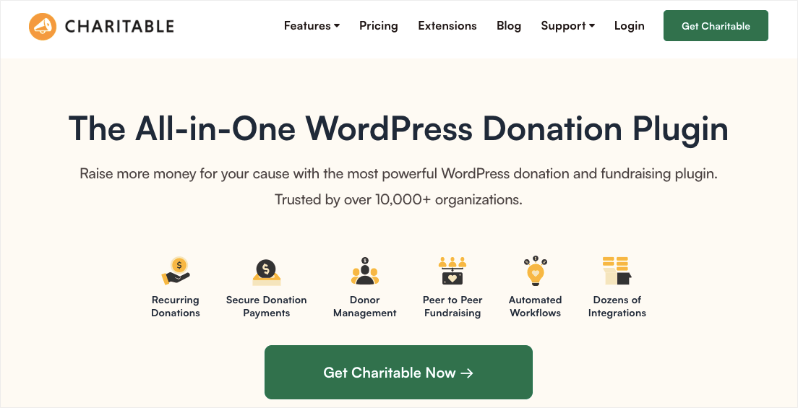
Charitable is the best all-in-one fundraising solution for non-profits running a WordPress website.
Unlike hosted platforms where you’re essentially renting space on someone else’s infrastructure, Charitable lives on your own site. That means you own everything: your donor data, your donor emails, your campaign history, and your brand.
We’ve worked directly with non-profits that had been using GoFundMe for years and had virtually no donor contact information to show for it. Migrating to Charitable meant building a real donor database for the first time, one they actually own and can use for future campaigns and outreach.
Charitable charges zero platform fees. You pay only the standard payment processor fees (Stripe, PayPal, and others are all supported).
Charitable Pro adds recurring donations, peer-to-peer fundraising, fee relief, ambassador programs, donor management, and a growing library of integrations including Mailchimp, ActiveCampaign, Zapier, and more.
With Charitable:
You can build campaign pages that match your brand, connect them to impact content (stories, updates, budgets), and keep donors in your ecosystem.
Recurring donations typically fit naturally into your on-site donor journey (campaign page → donate → thank-you → stewardship).
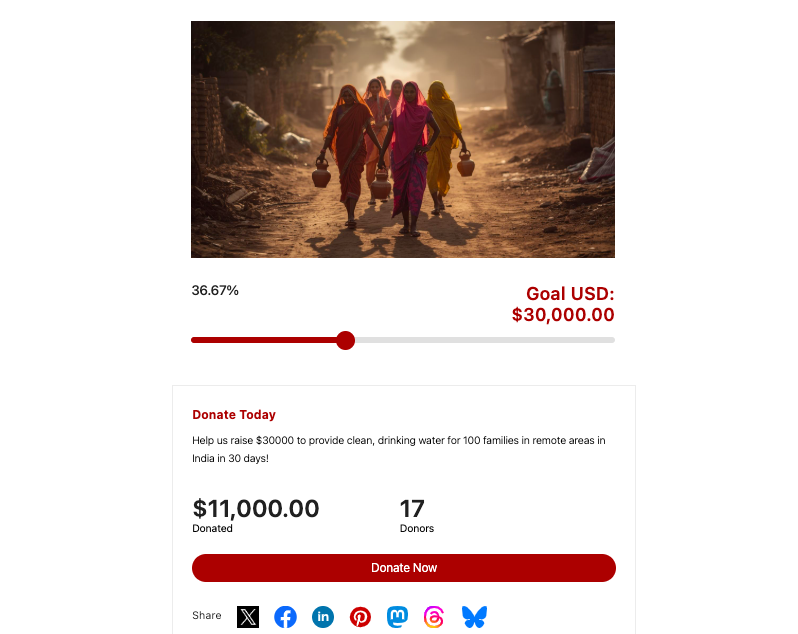
Setup is straightforward even for non-technical users. You can have a donation form live on your site in under an hour, and the campaign builder lets you customize everything from suggested donation amounts to goal progress bars and campaign end dates.
The honest downside: Charitable requires a self-hosted WordPress site and a hosting plan. If you have no website at all and just need a quick donation link to share on social media, there’s a learning curve to getting started. It’s the right long-term investment for any serious nonprofit, but it’s not the fastest path to a first donation link. Don’t have a website yet? Follow this video tutorial »

Not sure whether Charitable is the right way forward? Here’s a side-by-side comparison:
Here are the main reasons nonprofits choose Charitable over GoFundMe:
A fair note/caveat:
- GoFundMe can outperform for “viral reach” and speed if you don’t have much web traffic and want to lean on a well-known marketplace for sharing.
- Charitable requires WordPress + site maintenance (hosting, updates, payments setup). That control comes with responsibility.
2. Donorbox
Donorbox is one of the most widely used GoFundMe alternatives for nonprofits, and for good reason. Setup is fast, you don’t need a website to get started, and the free plan covers the basics well. You get a hosted donation page, recurring donation options, and the ability to embed a form on any website.
The platform supports a wide range of payment methods including Stripe, PayPal, ACH bank transfers, Apple Pay, and Google Pay. For nonprofits that need a reliable donation form quickly without managing software, Donorbox is one of the better options available.
Donorbox also offers a donor portal where supporters can log in to manage their recurring donations, update payment details, and download receipts. This reduces the administrative burden on your team significantly.
The honest downside: Donorbox charges a 1.5% platform fee on top of payment processor fees on the free plan. That fee is capped, but it adds up on larger campaigns. The free plan also includes Donorbox branding on your forms, which can undermine the professional, trust-building appearance nonprofits need. Removing it requires a paid subscription. For a full breakdown of how the two compare, see our Charitable vs Donorbox comparison.
3. Givebutter
Givebutter has built a reputation as one of the most modern-feeling fundraising platforms available. It covers donation forms, events, peer-to-peer fundraising, silent auctions, text fundraising, and livestream giving, all in one place. The interface is clean and the donor experience is polished.
It’s a strong pick for organizations that run a lot of events or want a single platform to handle multiple fundraising formats. The team dashboard and peer-to-peer tools are particularly well done, making it easy to run participant-driven campaigns like charity walks or giving day challenges.
Givebutter integrates with a wide range of CRMs and email tools including Salesforce, HubSpot, Mailchimp, and more. Their free plan is genuinely functional, not a stripped-down version designed to frustrate you into upgrading.
The honest downside: Givebutter uses a donor tip model to sustain the free platform. Donors are prompted to leave a tip for Givebutter on top of their donation, and the tip is pre-selected by default. Many donors don’t notice it and end up giving more than they intended. Some come back to the nonprofit confused or frustrated. It’s a legitimate business model, but it puts the cost of the platform onto your donors rather than your organization, and it can create awkward donor experiences you have no control over.
4. Zeffy
Zeffy markets itself as the only truly free fundraising platform for nonprofits, and there’s truth to that claim. There are no platform fees, no subscription fees, and no transaction fees charged to your organization. Zeffy covers its costs through optional donor contributions.
The platform includes donation forms, ticketing, peer-to-peer, and membership tools. It’s a legitimate option for small nonprofits with limited budgets that need a functional platform without any monthly cost.
The honest downside: Zeffy’s model works by prompting donors to add a tip to their donation, and that tip field is pre-checked at a suggested amount. The design makes it easy to miss. Many donors complete the donation without realizing they gave extra money to Zeffy, not the nonprofit. We’ve seen cases where donors noticed later and were upset, sometimes contacting the nonprofit rather than Zeffy. It’s a real risk to donor trust, and it’s one your organization doesn’t control. Zeffy is also US-only for nonprofits and has limited integrations compared to more established platforms. See our full Charitable vs Zeffy comparison for more on how the two stack up.
5. Fundly
Fundly is a straightforward crowdfunding platform that works well for single campaigns with a strong social sharing component. It’s simple to set up, doesn’t require a website, and includes Facebook integration that can help campaigns spread organically.
It’s a reasonable choice for one-off fundraising drives where speed and social reach matter more than long-term infrastructure. The campaign pages look clean and load quickly on mobile, which matters for social traffic.
The honest downside: Fundly charges a 4.9% platform fee on all donations, one of the higher rates in this category. On a $10,000 campaign that’s $490 going to the platform before payment processing fees. There’s no recurring donation functionality, limited donor management, and you don’t get strong ownership over donor data. It works for a one-time campaign but doesn’t build toward anything long-term.
6. Mightycause

Mightycause is built with peer-to-peer and team fundraising in mind. It handles giving days particularly well, which is why it’s popular for community foundation campaigns and Giving Tuesday events. Supporters can create personal fundraising pages on behalf of your nonprofit, and you get a clean dashboard to manage all of them in one place.
The platform supports recurring donations, tribute giving, and matching campaigns. There’s a free plan that covers basic fundraising, and a paid plan that removes platform fees and unlocks the peer-to-peer and team tools.
The honest downside: The interface feels dated compared to newer platforms like Givebutter. The free plan includes a platform fee on donations, which means you’re paying to use a product that isn’t as polished as what competitors offer at a similar price point. Customer support can also be slow, which is particularly frustrating during high-stakes campaign periods.
7. GoFundMe Pro
GoFundMe Pro, formerly known as Classy, is one of the most full-featured fundraising platforms available, designed specifically for larger nonprofit organizations. It covers donation forms, peer-to-peer, events, crowdfunding, recurring giving, and deep CRM integrations. If your organization is managing hundreds of thousands of dollars in donations and needs enterprise-grade infrastructure, GoFundMe Pro is a serious option.
The platform is polished, well-supported, and the reporting and analytics tools are among the best in the category. Salesforce integration is particularly strong.
The honest downside: GoFundMe Pro is, as the name makes clear, now fully part of GoFundMe. Classy was acquired by GoFundMe in 2022 and formally rebranded as GoFundMe Pro in 2025, so putting it on a list of GoFundMe alternatives comes with an asterisk: you’re still doing business with GoFundMe, just through its enterprise product instead of its consumer crowdfunding site. Beyond that, it’s expensive and not transparent about pricing upfront. It requires a sales conversation to get a quote, and contracts are typically annual. It’s genuinely overkill for most small and mid-size nonprofits, and the price reflects that.
8. Network for Good
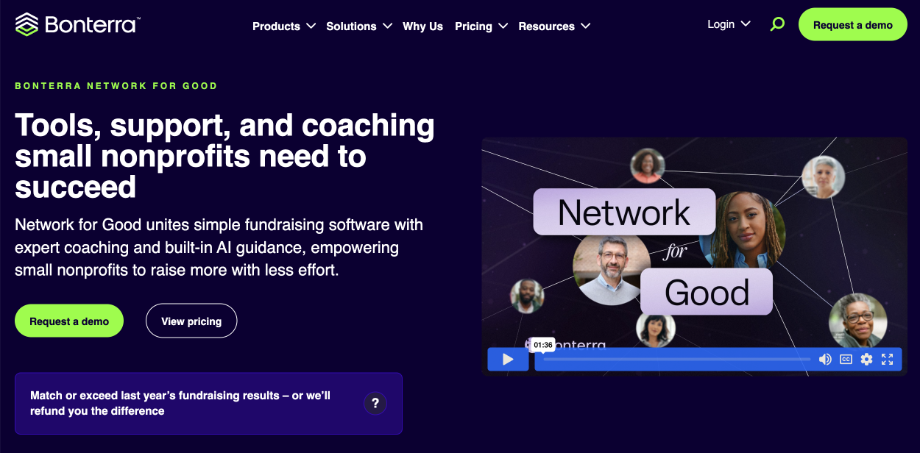
Network for Good combines online fundraising with donor management tools in a single platform, which appeals to nonprofits who want to reduce the number of tools they’re managing. You get donation pages, email fundraising, coaching resources, and a donor database all under one subscription.
It’s a reasonable option for small to mid-size nonprofits that want a guided approach to building a donor program and don’t want to stitch together multiple separate tools.
The honest downside: Network for Good requires an annual contract, which means you’re committing before you’ve fully evaluated whether the platform fits your workflow. The platform fee is 3% on top of payment processing, which is on the higher end. Some users also find the interface clunky compared to newer platforms. The coaching and educational resources are valuable for newer organizations, but more experienced teams may find they’re paying for resources they don’t need.
9. Bloomerang Fundraising
Bloomerang Fundraising, formerly known as Qgiv, covers a broad range of fundraising formats: online donation forms, event registration, text-to-give, peer-to-peer, and in-person giving kiosks. It’s a good fit for nonprofits that run a lot of events alongside their online fundraising and want everything managed in one system.
The text-to-give tools are among the better ones in this space, and the event management features go beyond basic ticketing to include table management, auction bidding, and mobile check-in.
The honest downside: Bloomerang acquired Qgiv and folded it into Bloomerang Fundraising, and the pricing adds up. The monthly subscription plus per-transaction fees can make it expensive relative to what you get, particularly for smaller organizations that don’t use the full feature set. Bloomerang has also signaled it wants the fundraising tools sold alongside its donor CRM, so organizations that only want the fundraising side without the CRM may find that path narrowing. The interface is functional but not the most modern, and customer support response times have been inconsistent based on the feedback we’ve heard from nonprofits using it.
10. GiveWP
GiveWP is a WordPress donation plugin that, like Charitable, keeps your fundraising on your own website and gives you full ownership of your donor data. It has a long history in the WordPress ecosystem and a large user base. If you’re already running WordPress and your team has experience with GiveWP, staying in that ecosystem makes sense.
The free core plugin handles basic donation forms, and the platform has a wide range of add-ons for recurring donations, peer-to-peer, fee recovery, and payment gateways.
Update – May 2026: GiveWP.com is no longer an independent product. On May 12th, 2026, the domain was absorbed into Liquid Web Software, and many nonprofits who had built their fundraising on GiveWP are now dealing with real uncertainty about what comes next. We’ve been hearing from a lot of organizations that are confused, concerned, and unsure about what to do. If that’s you, you’re not alone.
Our team at Charitable has been helping nonprofits navigate exactly this kind of transition for over a decade. Whether you have a simple setup or a complex one with years of donor records and recurring donations, we’re here to help you understand your options honestly, with no pressure and no sales pitch.
Here are the steps we recommend:
- Read the full breakdown: What Happened to GiveWP?: what the acquisition means for your site and your donors
- Reach out to our support team with questions about your specific situation. We’ll give you a straight answer about whether switching makes sense and what that process looks like.
- Try Charitable Lite for free. No commitment, no credit card required, and your GiveWP data can be imported automatically in just a few clicks.
- Let our team handle the migration for you. Our white-glove migration service is available exclusively to qualifying GiveWP customers. We move your donors, donations, and campaigns over to Charitable cleanly and safely, at no extra cost.
The honest downside: The free version of GiveWP is significantly limited. Recurring donations require a paid add-on, and many features that come standard in Charitable Pro require separate purchases on GiveWP with costs that stack up quickly. The platform’s future is now uncertain following its absorption into Liquid Web Software. It’s worth reading about what happened to GiveWP before committing.
11. Fundrazr
Fundrazr works for both personal and organizational fundraising campaigns, which makes it more flexible than purely nonprofit-focused platforms. It has strong social sharing tools and supports video, images, and updates within campaign pages to keep donors engaged throughout a campaign.
There’s a free plan and paid plans that reduce or eliminate platform fees. It’s a reasonable option for organizations running a mix of personal and organizational campaigns, such as teams where staff or volunteers run individual fundraising pages.
The honest downside: The free plan carries a 5% platform fee, which is high. Fundrazr is also less focused on the nonprofit use case than other platforms on this list, meaning nonprofit-specific features like tax receipt automation, 501(c)(3) verification badges, and donor management are limited. It’s closer to a general crowdfunding tool than a dedicated nonprofit fundraising platform.
12. JustGiving
JustGiving has one of the largest established donor bases of any fundraising platform, particularly in the UK. For international nonprofits or organizations with a UK audience, it carries significant brand recognition that can help campaigns attract donors who are already familiar and comfortable with the platform.
It supports individual fundraising pages, charity pages, and crowdfunding campaigns. Gift Aid integration for UK donations is a notable advantage for British nonprofits.
The honest downside: JustGiving takes a 5% platform fee on donations, plus payment processing fees. US nonprofits need to go through an eligibility verification process before accessing the platform. Customization is limited, donor data access is restricted compared to owning your own platform, and there’s no real path to building a long-term donor relationship infrastructure through JustGiving alone. It functions best as one of several channels, not as a primary fundraising platform.
13. Stripe
Stripe is not a fundraising platform. It’s a payment processor, and it belongs on this list because many tech-savvy nonprofits use it as the backbone of a fully custom giving experience. Stripe offers a discounted nonprofit rate of 2.2% + $0.30 per transaction, which is among the lowest available. Combined with a platform like Charitable that integrates natively with Stripe, you get maximum control with minimum platform overhead.
Stripe supports one-time and recurring donations, Apple Pay, Google Pay, bank debits, and a long list of international payment methods. For organizations with technical resources, building directly on Stripe gives you complete flexibility. If Stripe alone isn’t the right fit, we’ve rounded up the best payment gateways for nonprofits.
The honest downside: Stripe alone is just a payment processor. It has no donation forms, no campaign pages, no donor management, no tax receipts, and no fundraising tools. You need to build or integrate everything else on top of it, which requires either developer time or a plugin like Charitable. For nonprofits without technical staff, using Stripe directly is not a practical option.
How Much Should Your Online Fundraising Platform Cost?
This is one of the questions we get asked most often, and the answer requires unpacking what you’re actually paying for.
Most fundraising platforms charge in one or more of three ways: a monthly or annual subscription fee, a platform fee (a percentage taken from each donation), and the standard payment processor fee. Some platforms use a fourth model, the donor tip, to appear free while shifting the cost elsewhere. Understanding which of these you’re dealing with changes the math significantly.
What’s a Reasonable Transaction Fee?
Payment processor fees are largely unavoidable. Stripe and PayPal both charge around 2.9% + $0.30 per transaction for standard accounts, and most nonprofit-focused processors offer a small discount. You should expect to pay somewhere between 2.2% and 3% in payment processing on every donation.
Platform fees on top of that are where you should push back. A 4-5% platform fee on a $50,000 annual fundraising campaign costs your nonprofit $2,000-$2,500 per year in fees alone, before payment processing. That’s money that isn’t going to your mission. A platform charging 0% in platform fees with a reasonable subscription cost is almost always the better deal once you’re past a certain donation volume.
What About “Free” Platforms?
Free platforms aren’t actually free. They’re either sustained by donor tips (which affects your donor experience and trust), by limiting features until you upgrade, or by monetizing your donor data in ways that aren’t always transparent. Free is fine as a starting point. It’s rarely the right long-term answer for a nonprofit that wants to build lasting donor relationships.
Recap
What’s Worth Paying For?
The features worth paying for are the ones that compound over time: recurring donations (a reliable income stream), donor data ownership (so you can communicate with your supporters directly), and integrations with your CRM and email tools (so every donation enriches your broader donor program). A platform that handles all three well and charges a fair subscription fee will almost always return more value than a “free” alternative that does none of them properly.
For most small to mid-size nonprofits, expect to spend somewhere between $200 and $600 per year on a solid fundraising platform or plugin. That’s a modest investment compared to what even a 1% improvement in donor retention is worth over time.
Frequently Asked Questions
What’s wrong with just using GoFundMe for my nonprofit?
GoFundMe was designed for personal campaigns, not nonprofits. You don’t own your donor data, you can’t fully brand the experience, and there’s no infrastructure for building a recurring giving program. It works for a one-off campaign, but it doesn’t build toward anything. Every donor who gives through GoFundMe is GoFundMe’s relationship, not yours.
What’s the difference between a fundraising platform and a donation plugin?
A fundraising platform (like Donorbox, Givebutter, or Zeffy) is a hosted service. Your donation forms and campaign pages live on their servers. A donation plugin (like Charitable or GiveWP) installs on your own WordPress website, which means everything lives on your hosting. Plugins give you more control and data ownership. Platforms are faster to get started with and require no website.
Which platform has the lowest fees?
Charitable and GiveWP charge 0% platform fees. You only pay the payment processor (typically Stripe or PayPal). Zeffy and Givebutter also charge 0% platform fees but use the donor tip model instead. For the lowest total cost of fundraising, a self-hosted WordPress plugin with Stripe at the nonprofit rate is typically the best combination once you’re past the initial setup.
Do I need a WordPress website to use Charitable?
Yes. Charitable is a WordPress plugin, so you need a self-hosted WordPress site and a hosting plan. If you don’t have one yet, it’s a straightforward process to set up a self-hosted WordPress site, and the investment is worth it for any nonprofit that plans to fundraise online long-term. If you need something running today without a website, Donorbox or Givebutter are reasonable starting points while you build your site.
Is Zeffy really free?
Zeffy is free for nonprofits. Donors are asked to leave a tip that goes to Zeffy, and that tip field is pre-checked by default. So Zeffy costs nothing to the organization, but something to the donor, often without the donor fully realizing it. Whether that’s “free” is a matter of perspective, but it’s worth understanding before you choose it.
Can I use more than one fundraising platform?
Yes, and many nonprofits do. A common setup is using a primary platform for most donations (like Charitable on your WordPress site), plus a supplementary channel like JustGiving for donors who prefer that platform. The key is making sure your primary platform owns the donor relationship and that data flows back to your CRM or donor database.
What happened to Classy? Is it still around?
Classy was acquired by GoFundMe in 2022, and in 2025 it was fully rebranded as GoFundMe Pro. The underlying software is largely the same, but the Classy name is retired. For nonprofits that specifically want to move away from the GoFundMe ecosystem, that’s worth knowing, since choosing GoFundMe Pro means doing business with GoFundMe either way.
Ready to move beyond GoFundMe and build a fundraising platform you actually own? Get started with Charitable today. There’s a 14-day 100% money-back guarantee so you can try it risk-free.
Charitable Has 1+ Million Downloads!
Trusted by millions to power successful fundraising campaigns. Try Charitable risk-free today.
✅ 14-day money-back guarantee
✅ Transparent pricing
✅ Code-free setup
Stay Connected for More Nonprofit Resources
For more tutorials and videos tailored to nonprofits, subscribe to our YouTube channel. We regularly publish expert tips, step-by-step guides on online donations, fundraising strategies, and practical resources to help your organization succeed.
🗞️ Get weekly tips and exclusive guides in your inbox
Join our newsletter →
🎥 Watch step-by-step tutorials and success stories
Subscribe to our YouTube channel →
👩🏽💻 Connect with our community and get daily nonprofit insights
Follow us on LinkedIn →
🥳 Fun reels and non-profit insights
Follow us on Instagram →
👀 Insightful & fun videos to help you grow your cause
Follow us on TikTok→
🌎 Subscribe and follow for general fundraiser tips
Get Fundraiser Tips on TikTok →
Powerful Fundraising Resources
🤖 Use Charitable with Your AI Assistant
⬇️ Download proven strategies, campaign ideas, and expert tools
Get the Fundraising Kit →
💸 Get Free Fundraising Resources
Head to the Charitable Fundraising Hub →
🤔 Got questions about Charitable?
Charitable FAQs →
🏎️ Take Charitable for a spin
Create your Charitable Demo →
Understand non-profit terms and jargon
Non-Profit Glossary →
% Looking for non-profit deals and discounts?
Best Non-Profit Deals and Discounts →


Leave a Reply