
If you’re raising funds online, you’ve probably seen these lines:
“100% free fundraising software. Zero fees. No platform fee. No annual fee. Forever Free”
It is the kind of claim that makes you stop scrolling – especially when every dollar really does count for your mission.
I am not here to tell you those promises are lies. But I have spent 16+ years working in and around nonprofit fundraising, and I have learned that “free” is never actually free. It’s a business model and a cost-structure decision.
The costs exist. The question is always who pays them and when.
Pretty much everyone I talk to in the nonprofit space has looked at zero-fee platforms and felt the pull of that promise. Many have fallen for it too without fully understanding the model.
Sadly, most non-profits, churches, religious organizations, and goodwill causes find out about it too late and in the wrong way, usually from angry donors who were charges 17% of their donation as a contribution to the “free” platform – (without their knowledge in most cases).
Here is what is interesting: this is not a new story. Every time a new category of software promises to make money from “somewhere else,” the pattern repeats. The costs get real. They just move.
In this post, I want to walk you through exactly where they move. There are many platforms like GoFundMe, GiveButter, and FundRazr that follow this model. In this post, I’m focussing on Zeffy and GiveButter, two of the most prominent zero-fee fundraising platform right now – and what that means for your organization and the donors who trust you.
Table of Contents
- The Promise Sounds Almost Too Good to Pass Up
- How Zeffy’s “Free” Model Actually Works
- What the Numbers Look Like at Scale
- The Deeper Issue: What This Does to Donor Trust
- When This “Free” Model Can Actually Work
- What Transparent Fundraising Pricing Actually Looks Like
- How Charitable Approaches This Differently
- Frequently Asked Questions
The “Free” Promise Sounds Almost Too Good to Pass Up
Traditional fundraising platforms are genuinely expensive. GoFundMe charges 2.9% + $0.30 per transaction for individual campaigns. Many platforms layer a monthly subscription on top of that. Others take a percentage cut from every donation before the money reaches you. For a nonprofit raising $50,000 a year, those fees represent thousands of dollars that could have gone toward your programs instead of someone else’s infrastructure.
Against that backdrop, the pitch from platforms like Zeffy is genuinely compelling: what if the platform covered all of those costs? What if nonprofits could keep 100% of every donation?
Zeffy goes further than most. They charge nonprofits nothing – no subscription fee, no platform fee, no percentage of donations. They also cover payment processing. Stripe typically charges 2.9% + $0.30 per transaction. Zeffy absorbs that, too. For a nonprofit raising $50,000, that is roughly $1,600 in processing fees you would otherwise see deducted. So, the nonprofit gets it all.
I understand the appeal completely. I have worked with organizations where the decision between basic and better tools came down to whether there was $100 left in the budget at the end of the month. “Free” is not nothing when you are running a small operation on donated time and strained resources. If the math worked out the way the ads describe, zero-fee fundraising would be one of the best things to happen to the nonprofit sector in years.
But Zeffy is not a charity. It is a for-profit company with engineering teams, server costs, payment infrastructure, and staff to pay. The money to fund those things has to come from somewhere. And it does.
How “Free” Models Like Zeffy and GiveButter Actually Works
Zeffy is transparent about this on their website – the model is documented in their FAQ and on their “How We’re Free” page. Here is exactly how it works.
When a donor completes a donation, they are shown an optional tip prompt before checkout. The tip goes to Zeffy -not to the nonprofit. It is their only source of revenue. The tip covers their payment processing costs and funds the company’s operations. The nonprofit receives 100% of the donor’s stated donation amount. Zeffy receives the tip.
The tip is, technically, voluntary. Donors can reduce it or remove it entirely before completing their donation.
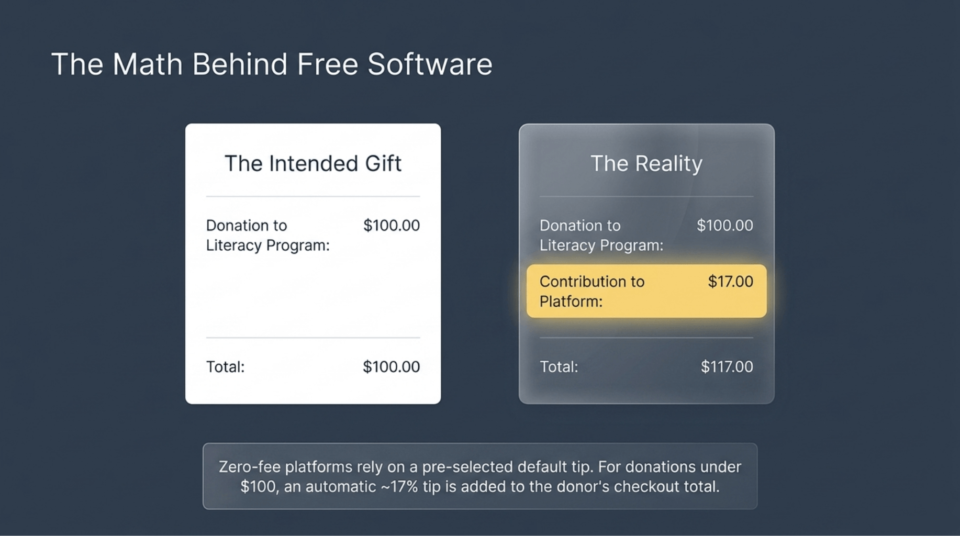
Here is where it gets important. The tip is pre-selected at a high default percentage. For donations under approximately $100, Zeffy’s default tip rate is around 17%. On a $50 donation, that means the donor sees a total checkout charge of $58.50. On a $100 donation, the default adds $17 – the donor sees a total of $117.
To remove or adjust that tip, a donor has to find and interact with a dropdown menu in the checkout flow. The dropdown is there. It is not hidden in fine print. But consider what is happening at that moment: someone is in the act of giving to a cause they care about, on a checkout page that looks like it belongs to the nonprofit, with a total that includes a suggested tip pre-filled. On mobile, in a moment of generosity, with no visual signal that adjusting the tip is the expected thing to do – many donors click through without touching it.
Zeffy acknowledges this openly in their own materials: on average, two out of three donors leave a tip. That statistic is not incidental. It is the engine that funds the entire platform.
There is a distinction worth drawing here between two kinds of transparency:
Disclosed transparency means the information exists somewhere – in the FAQ, on the “How We’re Free” page, in the fine print. Zeffy passes this test. If you go looking for how the business model works, you can find it.
Practiced transparency means the donor at your checkout, in the moment of giving, fully understands that they are being asked to pay an additional 17% on top of their donation to fund the software infrastructure. Whether Zeffy’s current checkout experience achieves this for most donors – given that the tip requires active opt-out, is presented as the default, and many donors don’t notice it – is a more complicated question.
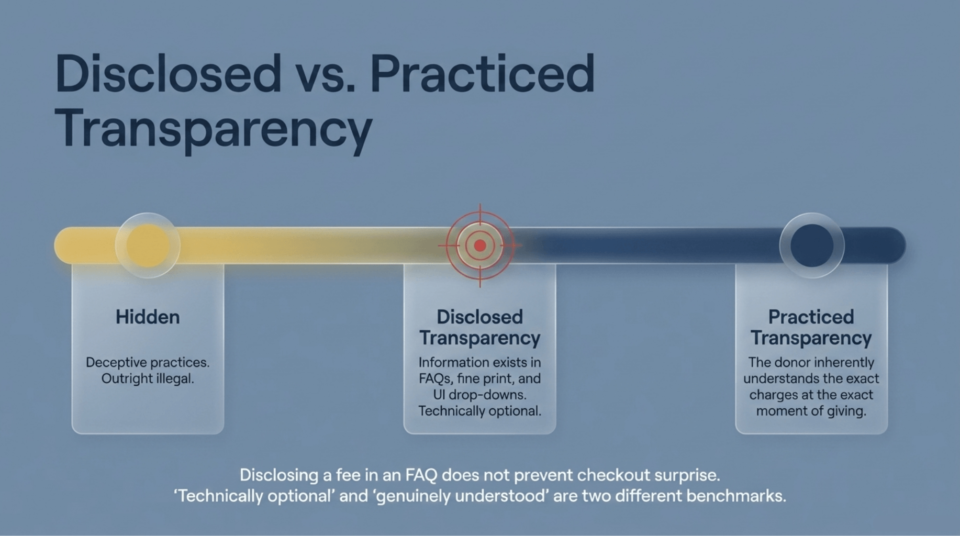
This is “technically disclosed” and “genuinely understood at the moment of giving” are different things. And that difference matters when the people going through that checkout are your donors – the people who trust your organization and are trying to support your mission.
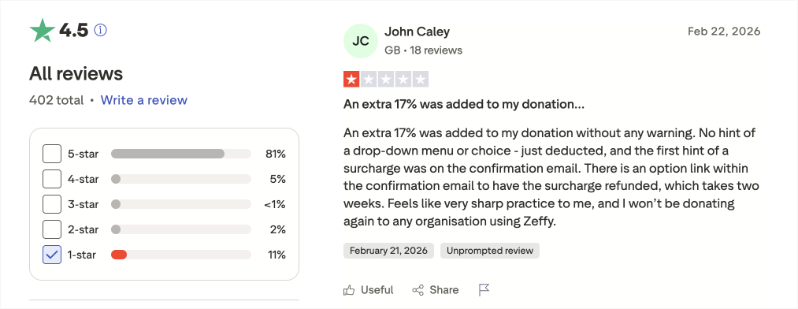
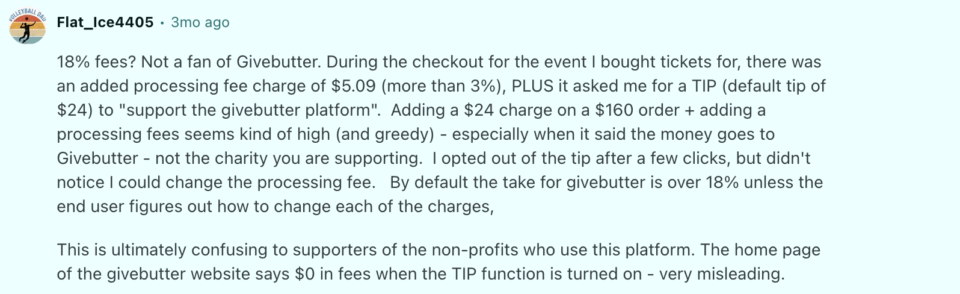
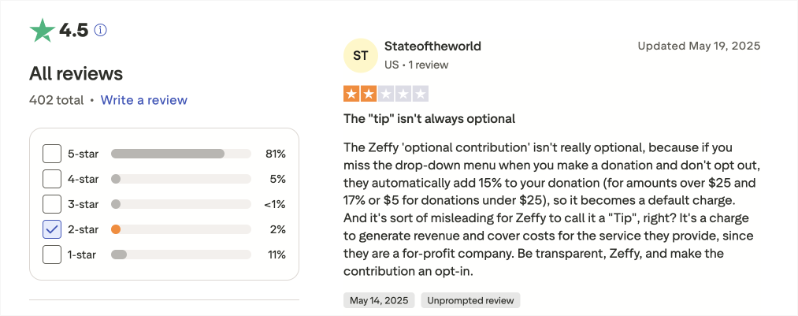
This model has left a bitter taste in donors’ mouths – so bad that they’ve claimed that they won’t donate to any organization that’s using Zeffy and GiveButter. That’s not my opinion, that’s straight from reading real reviews:
The same applies for GiveButter too:
What the Numbers Look Like at Scale
The real impact of this model depends on how much you raise and how many donors you have. Let me run the numbers on a realistic scenario so you can see where things land for your organization.
Imagine a mid-sized nonprofit, could be a food bank, a church building fund, a school PTA, running an annual campaign that raises $50,000. Around 600 donors, with an average gift of $83.
| Scenario | Platform cost (to nonprofit) | What donors pay | Nonprofit receives | Third party receives |
|---|---|---|---|---|
| Zeffy | $0/year | ~$55,644 total (intended $50,000 + ~$5,644 in default tips) | $50,000 | Zeffy: ~$5,644 |
| Charitable Lite (free) | $0/year | $50,000 (intended amount) | ~$48,370 (after Stripe processing) | Stripe: ~$1,630 |
| Charitable Pro Basic ($69/yr) | $69/year | $50,000 (intended amount) | ~$48,370 (after Stripe processing) | Stripe: ~$1,630; Charitable: $69 |
The math behind the Zeffy column: 600 donors × $83 average gift = $49,800. Two-thirds of donors (400) leave the 17% default tip. At $83 × 17% = $14.11 per tip, 400 donors contribute $5,644 to Zeffy. Donors collectively paid roughly $55,644 to give $50,000 to your cause.
The honest version of the Charitable comparison: with Charitable (free or paid), donors pay exactly what they intended. The tradeoff is that standard Stripe processing fees – typically 2.9% + $0.30 per transaction – are deducted from the donation amount before it reaches you. On $50,000 with 600 donors, that is approximately $1,630 going to Stripe. Your organization receives roughly $48,370. You also pay $0-$69 for the software itself.
Neither model is free of real costs. What is different is where the costs fall:
- With Zeffy, your donors pay an extra ~$5,644 to fund the platform – most of them without realizing it.
- With Charitable, your organization pays a small, predictable software fee (or nothing on Lite), and Stripe’s processing fee reduces what you receive – as it does with any payment processor on any platform.
Over five years at this fundraising level, donors would contribute roughly $28,220 in tips to Zeffy. Your organization would pay $345 in Charitable Pro software fees over the same period. The processing fee gap is real but largely unavoidable – Stripe charges every platform, and Zeffy absorbs it by routing tip revenue toward it.
I am not saying Zeffy is wrong for every organization. I am saying that the $5,644/year flowing from your donors to Zeffy is a real cost that does not appear on your budget. It appears on your donors’ credit card statements. But even if you’re fine with this, there’s more to it than just money.
The Deeper Issue: What This Does to Donor Trust
The financial math above is real and worth understanding. But I think the more consequential risk is not quantitative at all. It is about the relationship between your organization and the people who give to you.
Picture a retired teacher who gives $100 to your school’s literacy program every December. She gives because she believes in your mission, because she has for years, because she trusts you. She goes through your donation checkout, which looks like it belongs to your organization, and completes her gift. She sees $100 in the donation field. She clicks through.
When she checks her credit card statement, she sees a charge for $117. She does not remember agreeing to a $17 tip for a software company she has never heard of. She might email you and ask. She might just feel quietly unsettled. She might say nothing this year but give to a different organization next year, one whose checkout felt cleaner.
Now, not everyone lets it go. Many organizations have received bad reviews and been labelled “Frauds” by donors who caught this. If you’re lucky, the donor leaves Zeffy a bad review rather than one for your organization.
Another downside to your donors is that while the $100 donation is tax-deductible, the $17 tip is not.
What’s worse is that you will never see this in your data. Donor analytics do not log “reduced gift because checkout surprised them.” But the research on donor behavior is consistent: donors who feel unexpected charges, even small ones, give less frequently, at lower amounts, and with lower confidence in the organization. And retaining an existing donor costs roughly five times less than acquiring a new one. A donor who quietly stops returning is not a small problem; it is one of the most expensive things that can happen to a fundraising operation.
There is also a values question. The nonprofits I most respect are deeply committed to donor transparency – they send detailed receipts, they publish their financials, they work hard over years to build trust with the people who support them. Choosing a fundraising checkout that introduces ambiguity into the giving experience is at odds with that commitment, even when the platform, not the nonprofit, is the one responsible for the ambiguity.
Your fundraising platform is a piece of your brand. Your donors associate the checkout experience with you – with your mission, your values, your stewardship of their generosity. When that checkout quietly adds a $17 charge most donors did not consciously agree to, that sticks to your organization in donors’ minds, not to Zeffy’s.
See How AI is changing SEO for non-profits – what we’re observing and what to do about it »
When This “Free” Model Can Actually Work
I want to stop here and be fair, because this post is about helping you make a good decision – not about making a platform villain.
Zeffy is not a scam, neither is GiveButter. The software works. For very small organizations – a newly formed community group, an informal fundraiser, a nonprofit raising under $10,000 a year – it may genuinely be the right starting point. The zero-cost entry is real, and the trade-off (donors pay a default tip) may be acceptable, especially for an organization that truly has no software budget and no ability to absorb even a $69 annual fee.
There is also a more idealistic version of Zeffy’s argument that deserves acknowledgment: donors who choose to leave a tip are voluntarily supporting the infrastructure that makes nonprofit fundraising possible. If two-thirds of donors are genuinely choosing -with full awareness – to contribute to the platform that powers the software, that is a form of collective philanthropy. It is not a terrible framing.
The cracks appear in the word “genuinely.” The operative question is not whether donors can opt out. It is whether most donors, completing a checkout in two minutes on their phone, consciously process that they are being asked to fund a software company. The evidence, including Zeffy’s own customer support feedback and nonprofit community reviews, suggests that many do not. And “technically optional but practically defaulted” is a meaningfully different thing from “donors chose to tip.”
There is one approach that makes Zeffy genuinely defensible: proactively telling your donors about the tip model before they go through checkout. Some organizations do this in their campaign descriptions or donor acknowledgment emails. “Just so you know – our fundraising platform funds itself through optional tips at checkout. You can remove or adjust the tip before you complete your gift.” That is honest. That is transparent. Most Zeffy users, however, do not know enough about the model to do this – which is why posts like this one exist.
If you use “free” platforms like this today, this is not a reason to panic. It is a reason to get informed, communicate clearly with your donors, and consider whether the model still fits your organization as your fundraising grows.
What Transparent Fundraising Pricing Actually Looks Like
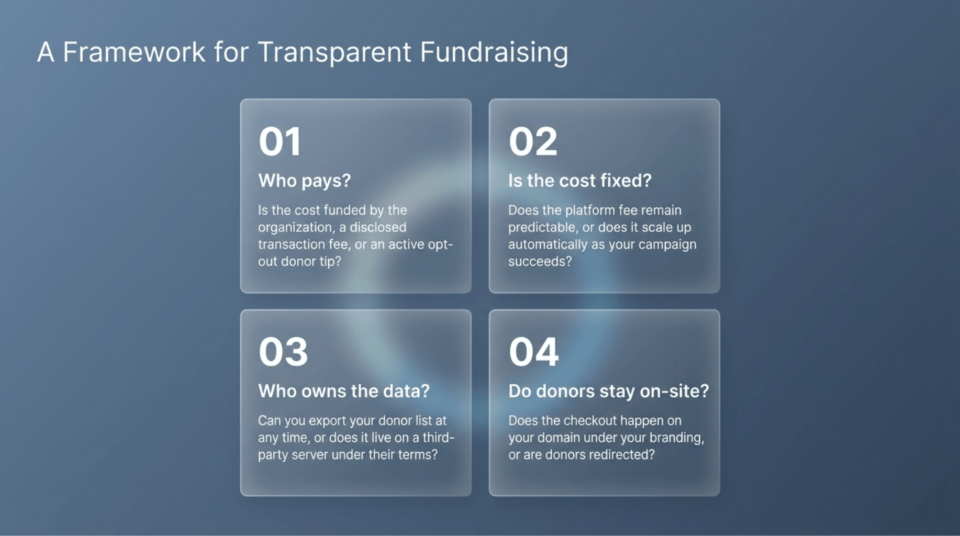
If you are evaluating fundraising platforms with this lens, here is a simple four-question framework. It applies whether you are looking at Zeffy, Donorbox, GoFundMe, Charitable, Give, or anything else.
1. Who pays, and is it clear to all parties?
Every fundraising platform needs revenue. A subscription paid by the nonprofit is transparent – the organization agreed to it. A percentage taken from donations is disclosed and consistent. A default tip added to donor checkout, requiring active opt-out, sits in a gray zone you should evaluate critically before building your donor relationships on top of it.
2. Is the cost fixed and predictable?
Percentage-based and tip-based models scale with your fundraising success. When your campaign doubles in size, your platform “fee” (paid by donors in tips) doubles with it. A flat annual software fee does not change regardless of how well your campaign performs – you can plan around it and budget for it.
3. Do you own your donor data?
When you fundraise through a third-party hosted platform, your donor list lives on their servers under their terms of service. Before you build your most valuable organizational asset – the list of people who have trusted you with their support – inside someone else’s system, read those terms carefully. Can you export your full donor list at any time? What happens to that data if you leave?
4. Do donors stay on your website?
Donors who give through your own website – on your domain, under your branding, without being redirected to a third-party page – are making a more direct association between the giving act and your mission. That matters for trust and for attribution. It also means you control the complete donor experience, not just the portion before the redirect.
For organizations running WordPress – and over 43% of all websites on the internet run WordPress – a self-hosted donation plugin checks all four boxes: fixed annual fee (or free), full data ownership, and a donor checkout that lives on your site, under your brand, with no tip prompts from anyone.
See GiveButter vs Charitable »
Want more non-profit advice like this?
How Charitable Approaches This Differently
I want to be transparent about something before this section: I am writing for the Charitable blog, so you should weigh what follows accordingly. That said, the reason I work here is precisely that I believe in this model. So let me lay out exactly how it works.
Charitable is a WordPress donation plugin used by 10,000+ nonprofits and downloaded over 1 million times. We built it for organizations that need complete control over their fundraising – their campaigns, their donor data, and their donor checkout – without giving a percentage of every donation to a platform, or asking donors to fund our operations through tip prompts they may not notice.
Here is how our pricing works, plainly stated.
Charitable Lite: Completely Free
Charitable Lite is available on WordPress.org at no cost. You can download and install it today and start raising money without investing anything. What you get:
- Unlimited campaigns, no cap on how much you can raise
- Donation processing through Stripe, PayPal, Square, and offline methods
- Full donor data ownership, your donor list stays in your WordPress database
- Automated donation receipts and admin notifications
- Campaign pages with fundraising goals, end dates, and progress bars
- CSV export of all donor and donation records
- Seamless integration with your existing WordPress theme, no custom CSS required
You will incur processing fees from your payment processor, such as Stripe. This goes directly to the payment processor and never goes through Charitable.
With Lite, there’s a minimal 3% transaction fee (and not 17%). It’s a small percentage of every donation that goes towards building and maintaining the plugin, as well as providing 5-star customer support.

Aside from this, there are no hidden fees or tip prompts added to your donors’ checkout.
Charitable Pro: A Flat Annual Fee – Nothing More
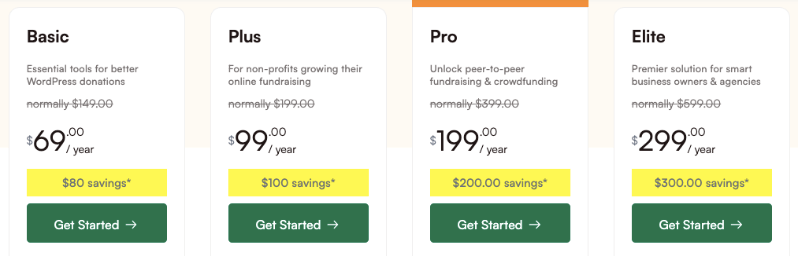
Our Charitable Pro plugin starts at $69/year for a single site.
Note: We offer the Charitable Pro plugin at 50% off for your first year, so you can get started with a smaller budget. We’re confident you’ll raise enough to cover those costs in no time. Our plans renew at full price from Year 2 onwards, starting at $149 per year.
We’ve created 4 tiered plans to match different levels and sizes of organizations based on their budget and needs.
See all four Pro tiers on our pricing page »
Here is what matters most about how Charitable Pro is priced:
- Charitable takes 0% of your donations. The annual fee is the only cost we charge. We are not in your transaction flow.
- Payment processing fees go directly to Stripe, PayPal, or your chosen processor. Typically 2.9% + $0.30 per transaction, going entirely to the processor – we never see it.
- No tip prompts. Your donor checkout includes no optional contribution to Charitable. Donors pay exactly what they intend to give.
The Pro plans add features you need as your fundraising grows.
The Basic plan ($69/year) adds on-site credit card processing, a visual campaign builder, donor management, PDF receipts, and customizable emails.
The Plus plan ($99/year) adds recurring donations, Fee Relief, email marketing integrations, and annual receipts.
The Pro plan ($199/year) unlocks peer-to-peer fundraising, crowdfunding, and automation integrations.
Elite ($299/year) covers five sites with multisite support and premium support.
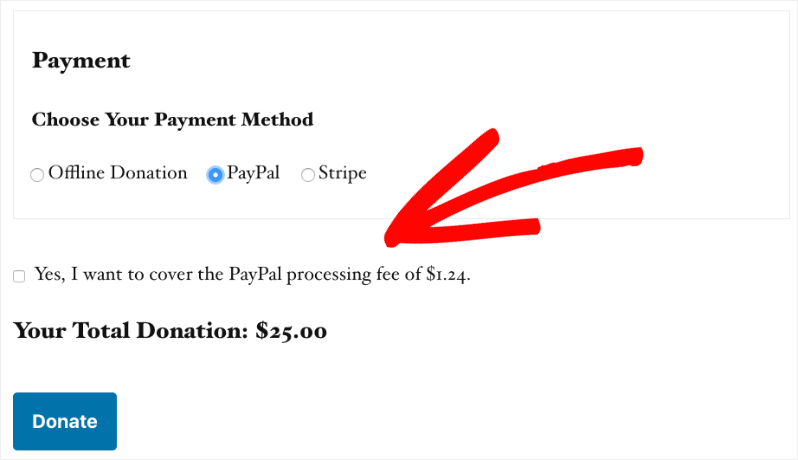
A note on Fee Relief, since it is relevant here: this Pro Plus feature lets your donors choose to cover Stripe’s payment processing fee on your behalf. The ask is explicit – it is labeled clearly in the checkout, it is opt-in (not opt-out), and the money goes to Stripe, not to Charitable. If a donor declines, they pay exactly what they intended to donate. That is how we think an optional-contribution model should work.
Every Charitable Pro plan comes with a 14-day, no-questions-asked money-back guarantee. If it is not the right fit for your organization, you get a full refund.
The bottom line is simple: you pay a flat annual fee for software you control. Your donors pay what they intend to give. Everyone in the transaction knows exactly where the money goes.
Charitable Has 1.2+ Million Downloads!
Trusted by millions to power successful fundraising campaigns. Try Charitable risk-free today.
✅ 14-day money-back guarantee
✅ Transparent pricing
✅ Code-free setup
Switching to Charitable Is Easier Than You Think
The biggest hesitation I hear from organizations considering a switch is the same one every time: “What happens to our donor history?” It is a fair question. Years of donor records, campaign data, and giving history are not something you can afford to lose, and the fear of starting over keeps a lot of organizations stuck on platforms that are not serving them well.
Here is the practical answer. Charitable’s CSV donor import tool lets you bring your full donor history in from any platform – Zeffy, Donorbox, Givebutter, GoFundMe, or anything else that lets you export a CSV. Map your columns, import your records, and your donor data is in your WordPress database from day one. No starting from scratch. No lost history.
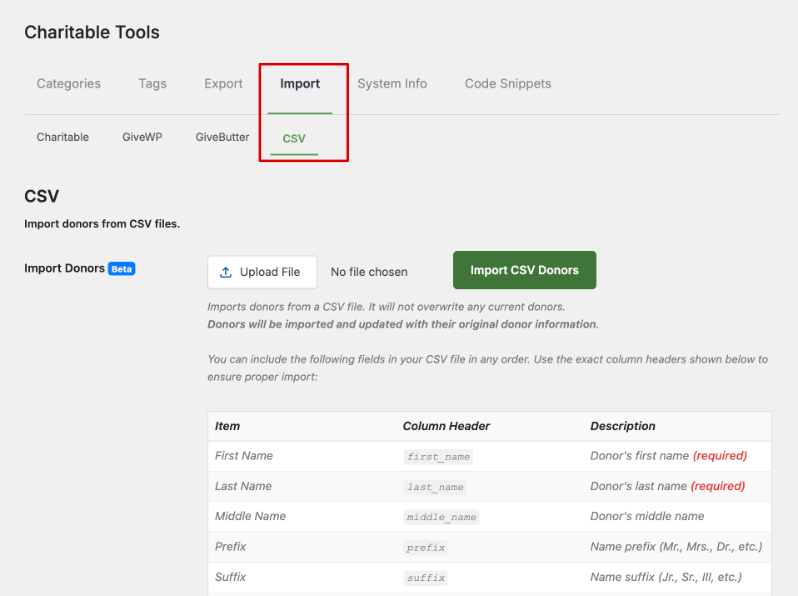
If you are moving from GiveWP or Givebutter specifically, we have built dedicated no-code migration tools for both. No manual CSV wrangling – just a guided process that moves your donors, donations, and campaigns over in a few clicks. The GiveWP migration guide walks through the full process step by step.
And if you would rather not do it yourself, our support team helps with migrations. Reach out before you start and we will walk you through it – or handle the heavy lifting with you. Contact our team here.
Need help? Our friendly customer support team is here to help you out every step of the way. Got a question about your CSV file, or need some guidance with the import? No problem! We’ve got your back.
Frequently Asked Questions
Is Zeffy really free for nonprofits?
Zeffy charges nonprofits no subscription fee and takes no percentage of donations. Their revenue comes entirely from optional tips that donors are prompted to leave during checkout. The nonprofit receives 100% of the intended donation amount. However, a default tip of approximately 17% (for donations under $100) is pre-selected at checkout, and many donors complete the transaction without adjusting it. Two out of three donors leave a tip on average. Whether this makes Zeffy “free” depends on how you define the cost – it is free for the organization, but donors collectively pay more than they intended to give.
What is Zeffy’s default tip percentage?
For donations under approximately $100, Zeffy’s default tip is around 17%. This is pre-selected at checkout. Donors can reduce or remove it entirely via a dropdown menu, but the UI does not prominently signal that adjusting the tip is expected or easy. On a $50 donation, the default tip adds $8.50; on a $100 donation, it adds up to $17.
Are donors told about the Zeffy and GiveButter tips before they donate?
These platforms disclose their model on their website – it is not hidden in a legal sense. But in most cases, the tip appears in the checkout flow as a pre-selected default, and donors complete the transaction without necessarily processing what the total charge represents. Whether donors fully understand they are funding the platform’s operations, rather than donating more to the nonprofit, varies by donor and device. Zeffy has received customer feedback noting that the prepopulated contribution to Zeffy is not clearly removable, and that some donors feel confused about the total charge on their statement.
Is it wrong to use a free platform like Zeffy for my nonprofit?
No. The right platform depends on your organization’s situation. For very small nonprofits with no software budget, Zeffy’s donor-tip model may be a reasonable trade-off. The most responsible approach, if you do use Zeffy, is to proactively inform your donors about the tip model before they go through checkout – so they can make a genuinely informed choice about whether to leave a contribution to the platform. Problems arise primarily when nonprofits and donors both operate without full awareness of how the model works.
What is a transparent alternative to Zeffy for WordPress sites?
Charitable is a WordPress donation plugin built for this. Charitable Lite is completely free – unlimited campaigns, Stripe and PayPal integration, full data ownership. Charitable Pro starts at $69/year and adds recurring donations, a visual builder, PDF receipts, email marketing integrations, and more. Charitable takes no percentage of donations. There is no tip prompt. Donors pay what they intended. Download Charitable Lite from WordPress.org to get started at no cost.
How does Charitable’s Fee Relief feature work?
Fee Relief is a Pro Plus feature that lets donors choose to cover Stripe’s payment processing fee on your nonprofit’s behalf. The ask is explicit – it appears at checkout as a clearly labeled, opt-in option. Donors who prefer to pay only their intended donation can skip it. The money covers the Stripe processing fee and goes directly to Stripe – none of it flows to Charitable. It is an opt-in choice with full transparency, not a pre-selected default.
Stay Connected for More Nonprofit Resources
For more tutorials and videos tailored to nonprofits, subscribe to our YouTube channel. We regularly publish expert tips, step-by-step guides on online donations, fundraising strategies, and practical resources to help your organization succeed.
🗞️ Get weekly tips and exclusive guides in your inbox
Join our newsletter →
🎥 Watch step-by-step tutorials and success stories
Subscribe to our YouTube channel →
👩🏽💻 Connect with our community and get daily nonprofit insights
Follow us on LinkedIn →
🥳 Fun reels and non-profit insights
Follow us on Instagram →
👀 Insightful & fun videos to help you grow your cause
Follow us on TikTok→
🌎 Subscribe and follow for general fundraiser tips
Get Fundraiser Tips on TikTok →
Powerful Fundraising Resources
🤖 Use Charitable with Your AI Assistant
⬇️ Download proven strategies, campaign ideas, and expert tools
Get the Fundraising Kit →
💸 Get Free Fundraising Resources
Head to the Charitable Fundraising Hub →
🤔 Got questions about Charitable?
Charitable FAQs →
🏎️ Take Charitable for a spin
Create your Charitable Demo →
Understand non-profit terms and jargon
Non-Profit Glossary →
% Looking for non-profit deals and discounts?
Best Non-Profit Deals and Discounts →


Leave a Reply