New in Charitable Pro 1.8.18
Charitable + AI
Run your fundraising by asking. Connect Claude, ChatGPT, or any assistant that works with WordPress, then describe what you want in plain English. Tutorials, videos and the full reference all live here.
New To AI? Start Here.
If you have used ChatGPT, you already know most of this. Here is what is new, and how to start.
Nothing to buy, nothing to install, and no setup inside Charitable.
What Is An AI Assistant?
A chat window. You describe what you want in plain language and it answers. ChatGPT, Claude and Cursor all work this way, though Cursor is aimed at developers.
What Changed?
Before, an assistant could only give advice about your site. Now it does the work inside Charitable while you watch.
Why Does It Matter Here?
Small teams rarely have a developer on call. Whoever knows what the fundraiser should say can now just describe it.
Check Your Versions
Charitable Pro 1.8.18 or later, on WordPress 6.9 or later. On 6.8 nothing registers.
Add The Connector
Your assistant reaches your site through a small bridge. WPVibe is a free one.
Turn On Write Access
Charitable > Tools > AI MCP. It stays off until you switch it on.
Ask For Something
"Set up a fundraiser for the animal shelter, $5,000 goal." That is the whole job.
Setup, Step By Step
The detail behind those four cards. Five steps, once. Your assistant can read straight away and cannot change anything until you say so in step 5.
- Check your versions. WordPress 6.9 or later, Charitable Pro 1.8.18 or later. On WordPress 6.8 or earlier nothing registers and nothing about your site changes.
- Add a connector to your assistant. Assistants reach your site through a small bridge. WPVibe is a free one that works with Charitable out of the box.
- Create an application password. In WordPress, go to Users > Profile, scroll to Application Passwords, name it after your assistant, and click Add New Application Password. Copy it immediately, because WordPress shows it once. This section only appears on sites served over HTTPS.
- Connect your site. Give your assistant your site address, your username and that password. If your connector offers a one-click approval link instead, take it, and you never type the password at all.
- Turn on write access. Go to Charitable > Tools > AI MCP and turn on Enable AI write access. Leave it off and you still get a genuinely useful read-only assistant for reporting.
Full Instructions
The complete setup guide and the full operation reference.
Getting started with AI assistants
Connect an assistant in five steps, with write access off until you turn it on.
AI assistants in Charitable: the full reference
All 29 operations, how permissions map to roles, and what is deliberately out of reach.
All Charitable documentation
Every guide for the plugin and its add-ons, in one place.
Prompts To Try
Copy any of these and change the details to match your own fundraising. Ask in your own words if you prefer, because you never need to name an operation or fill in a form.
Build a campaign
Set up a fundraiser for the animal shelter, $5,000 goal, ending at the end of next month
You get a real campaign in the Campaign Builder, from a template the assistant picks from your words, with suggested amounts scaled to your goal. It arrives as a draft.
Create a campaign for our winter coat drive with a $2,500 goal
What campaign templates can I choose from?
Customize the donation form
Add a question asking how they heard about us
Make that a dropdown instead: Facebook, a friend, or our newsletter. Default it to our newsletter.
Choice fields can carry their own options and a pre-selected default, in one request.
Make that campaign’s donate button green
Only the button changes. Nothing else moves.
Move the phone number field above the payment section
Record a gift that came in offline
Someone posted a check for $250 from Jane Smith, record it
It will ask for the donor's email address, and it should, because donors are matched on email and inventing one would split or merge real records.
Record a $1,000 cash donation to the winter coat drive
Ask about your fundraising
Who are our biggest supporters?
Ranked over your whole history. Never includes an email or postal address.
Which campaign has raised the most?
What did we raise last month compared to the month before?
How many donors gave more than once this year?
Show me a day by day breakdown for the winter coat drive
Diagnose a problem
Why aren’t my donations showing up?
It reads your gateway and test-mode status, so you get a real diagnosis instead of a guess.
Is my site still in test mode?
Which payment gateways are set up?
What can my Charitable site do?
Safe By Design
Nothing is exposed to anyone who could not already do it in your dashboard. Every operation checks a Charitable capability before it runs.
Changes are off until you turn them on
A connected assistant reads immediately and cannot change anything until an administrator enables write access under Charitable > Tools > AI MCP. Ask it to build something with the gate off and it refuses, then tells you the exact switch to flip.
Payment credentials are never readable
Your Stripe, PayPal and Square keys are not in anything an assistant can see, whoever is asking.
Donor lists never include email or postal addresses
Reading a named donor’s contact details needs the sensitive-data capability, so one permitted read cannot become a bulk export of your donor file.
There is no permanent delete for a campaign
An assistant can move one to the trash, which is reversible, and nothing more. It also refuses to trash a campaign that already has donations unless you confirm.
New campaigns are drafts
Unless you ask for otherwise, so nothing goes live by accident.
Every change is logged
Charitable > Tools > Logs, filtered to Abilities, records what an assistant did. Charitable > Tools > System Info has an Abilities API section, the first place to look if a client connects but cannot see your data.
What You Can Do With AI
In Charitable Right Now
Twenty are reads and nine are writes, every one registered with the core WordPress Abilities API.
Charitable registers its operations with the WordPress Abilities API, which arrived in WordPress 6.9. That is a core WordPress feature, not a Charitable one. Charitable did not build an integration with any single assistant. It publishes what it can do to WordPress, and whatever client you connect reads the same list, so a new assistant works on day one with nothing for you or us to do.
Plugin and licence info, site environment, and gateway status. Never keys or secrets.
3 readRead onlyList, read, create, update, status, trash and restore, plus donation form fields and Design styles.
6 read8 writesList, read, record a gift that came in offline, and summarise totals.
3 read1 writeList donors and totals, and read one donor in full where permitted.
3 readRead onlyOverview, day-by-day activity, top campaigns, top donors, and named date ranges.
5 readRead onlyEach operation carries a description written for the assistant, telling it when that operation is the right choice and what its values mean. The complete list, how permissions map to roles, and what is deliberately out of reach are all in the full reference.
Watch And Learn
Short walkthroughs of Charitable and AI. Click any thumbnail to play it here.
Visit Our YouTube ChannelFrequently Asked Questions
The things people ask before connecting an assistant to a live fundraising site.
Do I need to install a Charitable add-on for this?
No. There is no add-on to buy, nothing to install, and no setup inside Charitable at all. If you are running Charitable Pro 1.8.18 or later on WordPress 6.9 or later, the operations are already registered and waiting for a client to connect.
Which AI assistants work with Charitable?
Any assistant that reads the WordPress Abilities API. Claude, ChatGPT and Cursor are the ones we have used. Charitable did not build an integration with one company’s AI, so when a new client appears it works with Charitable on day one with nothing for you or us to do.
Can an assistant see my donors’ email addresses?
Donor lists never include email or postal addresses, whoever is asking. Reading one named donor’s contact details requires the sensitive-data capability, so a single permitted read cannot become a bulk export of your donor file.
Could an assistant reach my payment keys or move money?
No. Your Stripe, PayPal and Square credentials are not included in anything an assistant can see. It can tell you which gateways are enabled and whether each is configured, and nothing more.
Can an assistant delete one of my campaigns?
There is no permanent delete. An assistant can move a campaign to the trash, which is reversible, and that is all. It will also refuse to trash a campaign that already has donations unless you confirm.
How do I stop an assistant making changes?
Changes are off until you switch them on. A newly connected assistant can read everything and change nothing until an administrator enables write access under Charitable > Tools > AI MCP. You can turn it back off whenever you like, and reads keep working either way.
How do I see what an assistant actually did?
Go to Charitable > Tools > Logs and filter to Abilities. Every change an assistant makes is recorded there. Charitable > Tools > System Info also has an Abilities API section, which is the first place to look if a client connects but cannot see your data.
What happens if I am still on WordPress 6.8?
Nothing registers and nothing about your site changes. The Abilities API arrived in WordPress 6.9, so 6.9 is the floor for any of this to work.
For Developers
An AI assistant is only one consumer of the Abilities API.
Everything here is reachable from your own code.
None of this is Charitable-specific plumbing. Charitable registers its operations with the WordPress Abilities API, which landed in core in WordPress 6.9. Any plugin can describe what it can do, and any connected client reads the same description.
An AI assistant is only one consumer
Every operation is equally reachable from your own PHP, from WP-CLI, or from any HTTP client. If you have been writing custom queries against Charitable’s tables to build a report, an ability is a supported alternative that fires the plugin’s own validation and capability checks.
The write gate is a filter
It defaults to the ai_mcp_write_enabled setting, which is off on a site that has never set it, and you can override it in code. This is the clean way to guarantee an assistant can never write on production while leaving it on in staging.
add_filter(
	'charitable_abilities_allow_write',
	function ( $enabled ) {
		if ( function_exists( 'wp_get_environment_type' ) && 'production' === wp_get_environment_type() ) {
			return false;
		}

		return $enabled;
	}
);
The gate keys off each operation’s own readonly annotation rather than a list of operation names, so a write operation added in a later release is covered by that filter automatically. Permission checks are separate and always run: every operation tests a Charitable capability before it does anything, so the gate sits on top of your role setup rather than replacing it.
This Is Just The Start
Charitable Pro 1.8.18 covers campaigns, donations, donors and reports. Support for the add-ons is next, and this page is where each one gets documented as it lands.
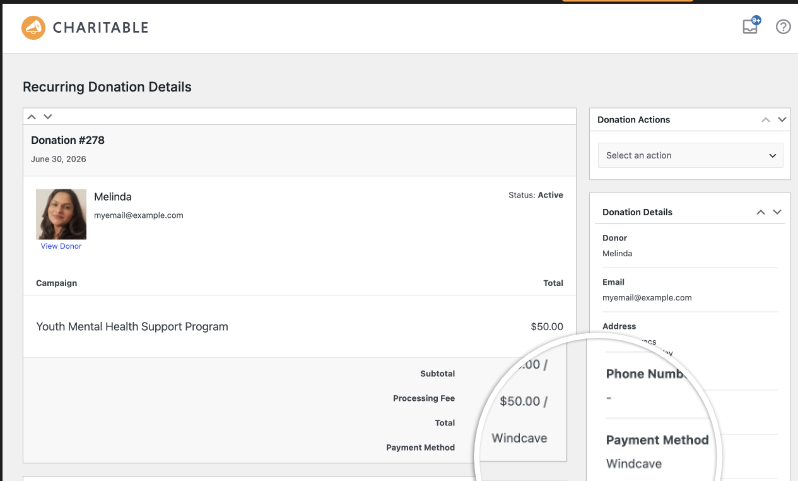
A donor sets their gift up once on Windcave’s secure payment page, and Charitable bills every renewal after that on schedule. Why this is important:
🏦 Organizations banked in New Zealand or Australia: monthly giving on the gateway your bank already set you up with, with no second processor to onboard.
⛪ Churches taking regular tithes and offerings: congregants set their own schedule once, which is the simplest way to launch recurring church giving without a separate platform.
🌏 Groups with donors in several currencies: Windcave handles more than 20, so a supporter can give in the currency they actually hold.
📅 Operating funds rather than one-time campaigns: switch on Recurring Only mode and the one-off option disappears, so every gift to that campaign is a subscription.
🧾 Teams with no developer on staff: 3 sets of credentials pasted into a settings page, and no code anywhere.
Charitable Automation Connect 2.3.0 introduces the Visual Automation Builder, a full-screen canvas that lays each automation out as a flow of connected cards: a trigger, optional conditions, and a list of actions that run in order.
🧩 Many actions, one trigger: Tag a donor, send an email, add a note, and fire a webhook from a single event, dragged into any order.
✉️ Act inside Charitable: New Send Email, Tag Donor, and Add Donor Note actions run with no external service required.
🔤 Merge tags: Personalize emails and notes with live fields like {first_name}, {total}, and {campaign_name}.
🔁 Apply to existing donors: Run Tag Donor and Add Donor Note against the donors you already have.
🖥️ Canvas or Simple: Switch views anytime, and automations built before 2.3.0 keep working unchanged.
Read more here.
The moment a supporter makes a gift is when they are most engaged. With the new Brevo integration for Charitable, you can automatically turn those one-time donors into long-term subscribers without touching a single spreadsheet.
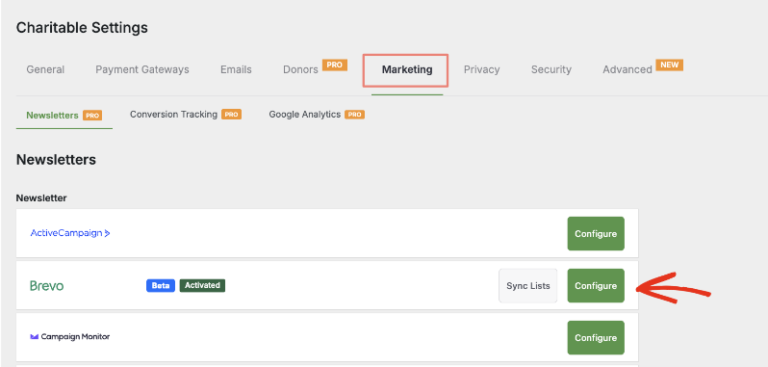
Simply collect donor consent right on your donation form and start your welcome series immediately.
What’s New:
🔄 Automated Subscriber Sync: New donors who opt in are added straight to your Brevo contact list as soon as their payment clears—no manual exports or CSV imports required.
🎯 Granular Consent & Opt-In Control: Customize your checkbox label, choose whether it defaults to checked or unchecked, or turn on Brevo double opt-in to keep your list clean and compliant.
📋 Per-Campaign List Mapping: Route supporters to your global email list or map specific campaigns to targeted Brevo lists to tailor your follow-up messaging.
⚡ 5-Minute Setup: Connect instantly by pasting your Brevo API key into the Newsletter settings, map your contact fields, and start building your email list on autopilot.
Ready to grow your mailing list? Brevo is available now starting on the Charitable Plus plan—connect your account today!
newExpired or updated credit cards are one of the biggest silent leaks in recurring fundraising. With Card Updates in the Recurring Donations extension, donors can now refresh their payment details directly—keeping their subscription, schedule, and giving history completely intact.
No canceled plans, no lost history, and zero administrative headache for your team.
What’s New:
⚡ 30-Second Self-Service: Donors get a dedicated “Update Card” button in their dashboard that opens Stripe’s secure, PCI-compliant Customer Portal to update card details instantly.
🔒 Scoped & Safe Access: Scoped exclusively to card updates by default, donors can’t accidentally cancel or alter their plans from inside the portal, keeping your webhooks and data in sync.
🤝 Admin-Assisted Support: Helping a donor on the phone? Open their secure Stripe portal in one click from your admin screen or generate a single-use update link to email them.
📋 Automatic Audit Trail: Every payment method update is recorded automatically with a timestamp in both system-wide logs and the individual donor’s profile.
Ready to protect your recurring revenue? Get the Plus or Pro plan and update Recurring Donations to 2.3.0+ and enable “Update Payment Method” under your Settings today!
With our new native Divi 5 module, you can anchor your microsites with real-time fundraising stats directly on the visual canvas. Here’s how it works, and why it’s worth turning on today.
Create campaign updates that are VISUAL AND LIVE. You can also:
📊 Campaign Progress Bar: Drop a live progress bar into any Divi 5 layout and show goal progress in real time.
🎨 Deep styling controls: Easily customize the bar and track color, height, and radius to match your brand perfectly.
👁️ Visual Builder ready: Configure and preview everything directly on the Divi canvas as a first-class module.
🔁 Identical rendering: The same exact engine powers this module, meaning consistent design without legacy shims.
✅ Faster launches: Never leave the Divi 5 interface to configure shortcodes or guess how your goal labels will look.